

Blog Structuring
Original Publish Date: 06/17/2025 by Anthony Madalone
Last Edited on: 06/17/2025 by Anthony Madalone
1. Secure the Blog Brief!
When structuring a blog, that blog’s brief should (in theory) tell you everything you need to know about how to structure it — including key keywords, content to include, and so on. Translating briefs to outlines should be like translating English to English!
Let’s say you’re doing content for Hospitality Network. Go into the content calendar, and find the brief for the month you’re working on! For the purposes of this exercise, we’ll use this brief:

2. Make Your H1
Next, you’ll want to put in your H1. This one doesn’t require a lot of thought H1; the H1 should be the title of the blog itself! So take that blog title and tag it as such:
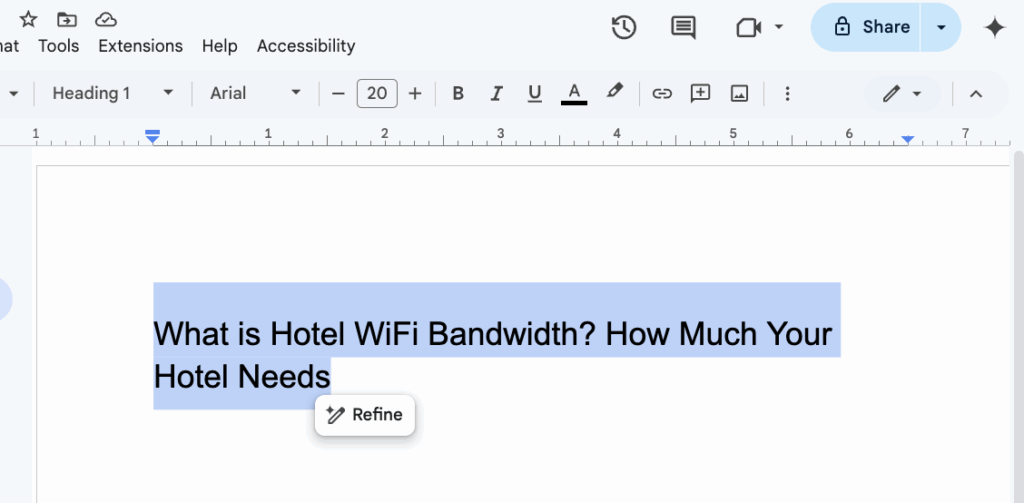
Heck yeah. Great start!
3. Make Your Subheader H2
Next comes a header I refer to as the “subheader H2.” This header leads directly into the intro, and serves as an elaboration on what the blog will actually be about going forward. Because it doesn’t frame any specific content section, this header is a great place to include additional keywords that don’t inherently fit into the structure of your blog.
For example, in this case, some users search for “hotel bandwidth” queries with the qualifier “need”. Thus, I framed the subheader H2 accordingly:

4. Make Your Body H2s, Alongside H3s As Needed!
Now comes the meet of the blog — your body H2s. These are the H2s where you’ll hit specific keyword targets, dictated by the outline already prescribed in the blog brief.
Let’s look back at the blog brief pictured above. The brief outlines that the blog will answer common FAQs about bandwidth at large, mentioning specific FAQs to include. It also mentions discussion of the specific needs of hotels, and that this blog will highlight them. Covering all of those bases, you can put together an outline that looks like this:

Voila! Feels smooth to me. These headers should, in fact, pretty much right themselves.
5. Conclude!
Once you get those body headers ready to go, it’s time to make your final header — a concluding H2. Similar to the subheader H2, this H2 can include any keyword targets you may have missed in initial headers. It’s also the time to, in most cases, fully tie this blog back into the brand.
These headers already cover a lot of key terms we’re looking to rank for; in any technical blog, however, it’s never a bad idea to include the term “uses cases” if you get the chance. Ultimately, this lead me to this final H2:

And there you have it — a full blog outline!